Osprey®25 — THE PREMIER DISTORTION, ANISOTROPY AND SURFACE INSPECTION IN A SINGLE FOOTPRINT
100% of every lite, scanned live at the furnace exit. Every distortion. Every anisotropy value. Zero blind spots.
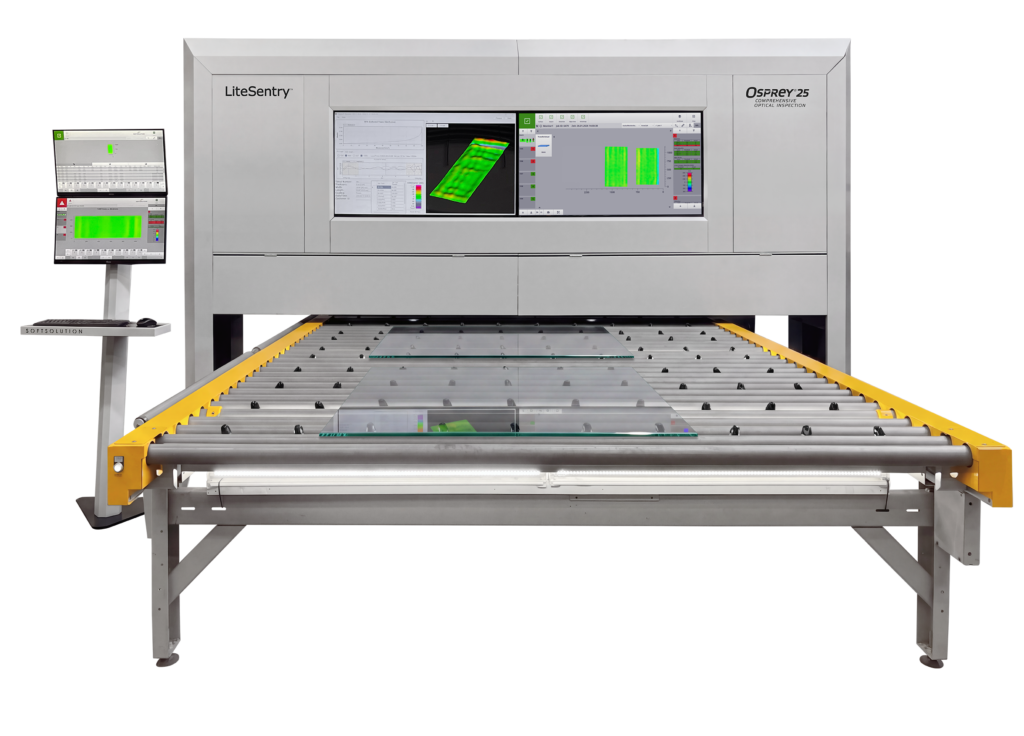
Distortion, Anisotropy & Surface Inspection – One System
25 years of development went into this. Osprey®25 measures distortion in every direction at once, right to the edges — including the types manual methods can’t even see.
With optional best-in-class anisotropy and surface quality inspection, all results are combined in an intuitive, fully customizable user interface and stored securely in an SQL-based database.
One System. Complete Glass Quality Control.
Osprey®25. The most trusted system in the world
More than 800 Installations worldwide.
25+ years of experience.
Patented.
Global Service & Support with 2 main hubs
In Europe & North-America.
Regular software enhancements
Osprey®25 | |
Quality check | . |
Edge Chips | . |
Dimension Check | . |
Logo Position & Quality Check | . |
Distortion Check | . |
Anisotropy Check | . |
White Haze | . |
Glass Thickness Check | . |
Glass Type Recognition | . |
Data Matrix Code Interpretation | . |
The ONLY OPTICAL TECHNOLOGY that measures all forms of distortion in all directions.
Osprey®25. How it measures
The Superior Solution for Distortion
One optical measurement. A complete, repeatable map of every deformation on the glass.
It can do ALL KIND OF DISTORTION, not ONLY Rollerwave and Edgelift.
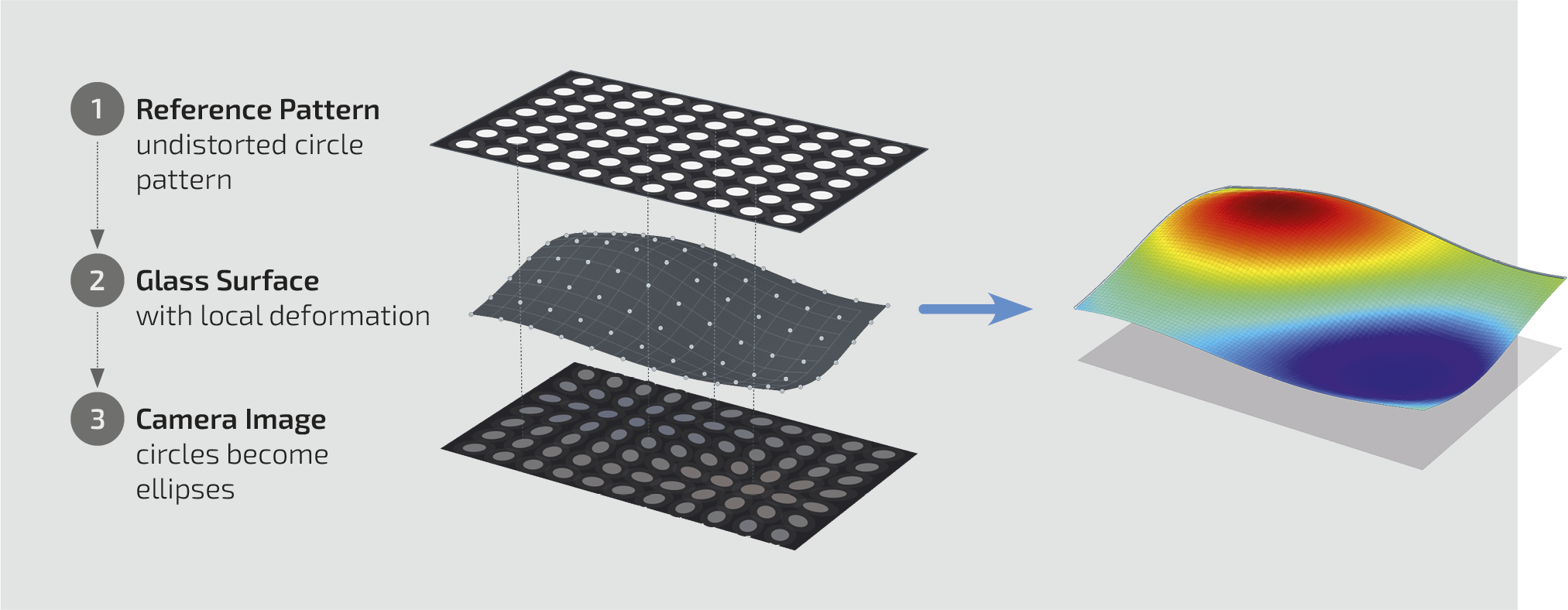
A regular pattern of circles is projected onto the glass surface. The shape, size and orientation of the resulting ellipses in the camera image indicate the direction and magnitude of the local surface deformation, allowing Osprey®25 to calculate a complete deformation map of the glass.
Millidiopter, not just peak-to-valley
Same peak-to-valley depth. Wildly different distortion your customer will actually see. That’s why the top fabricators measure millidiopter too — and Osprey®25 reports both, in mm or inches.
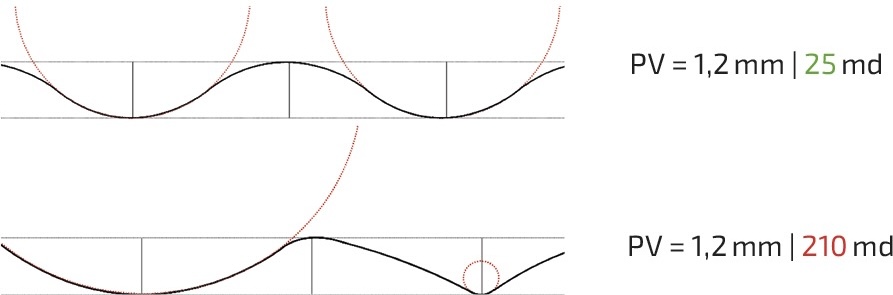
And not only in mm, also in milliDiopter!
The most precise anisotropy measurement
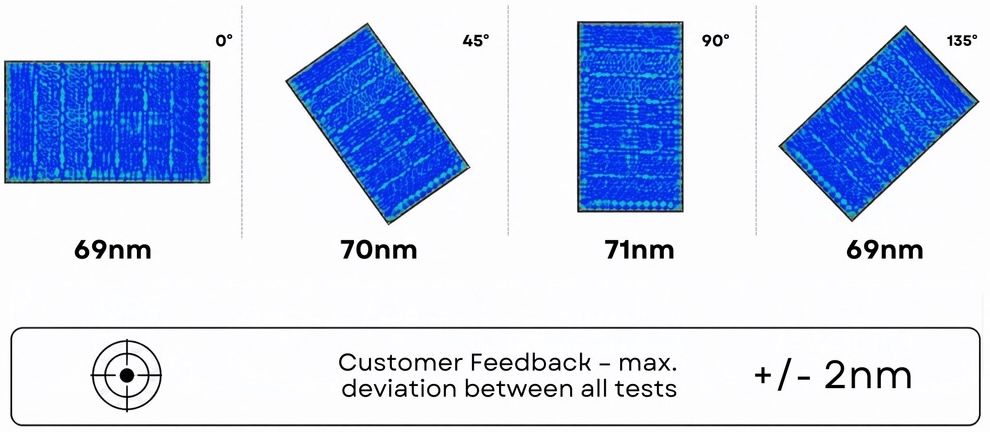

10–800 nm measurable anisotropy range

±10 nm accuracy — the most precise in the market

±2nm max. deviation across all rotation angles (customer field data)
Osprey®25. What you can expect
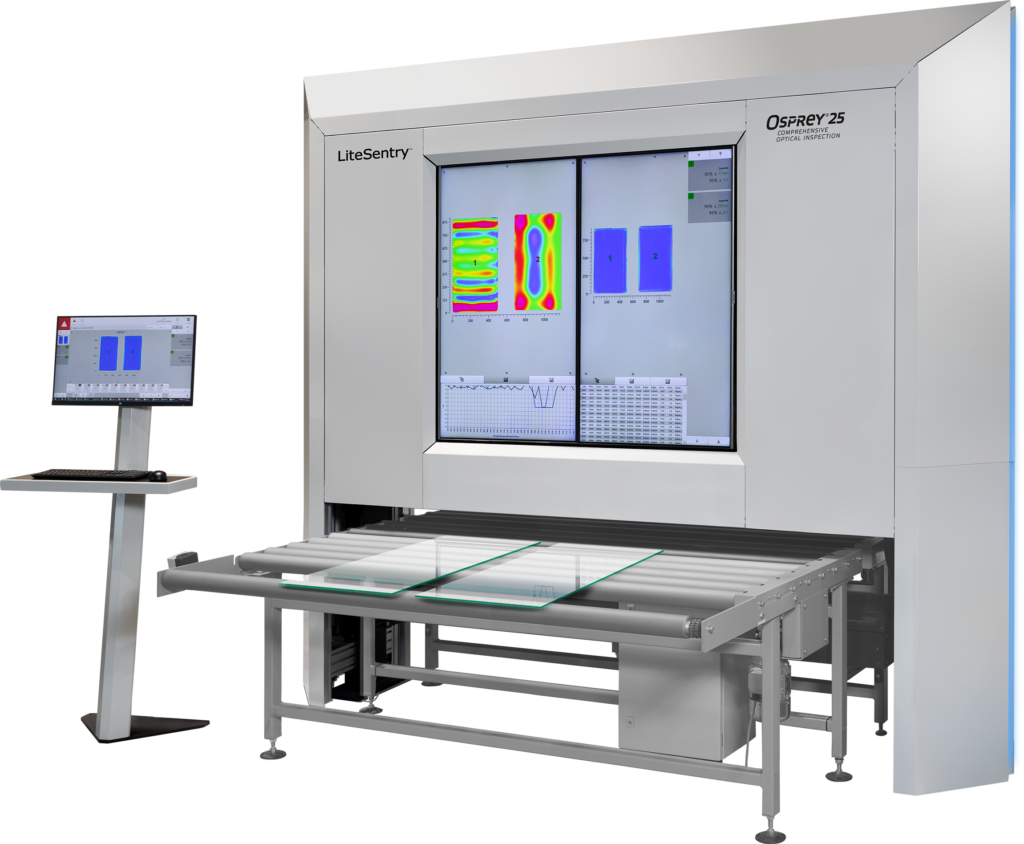
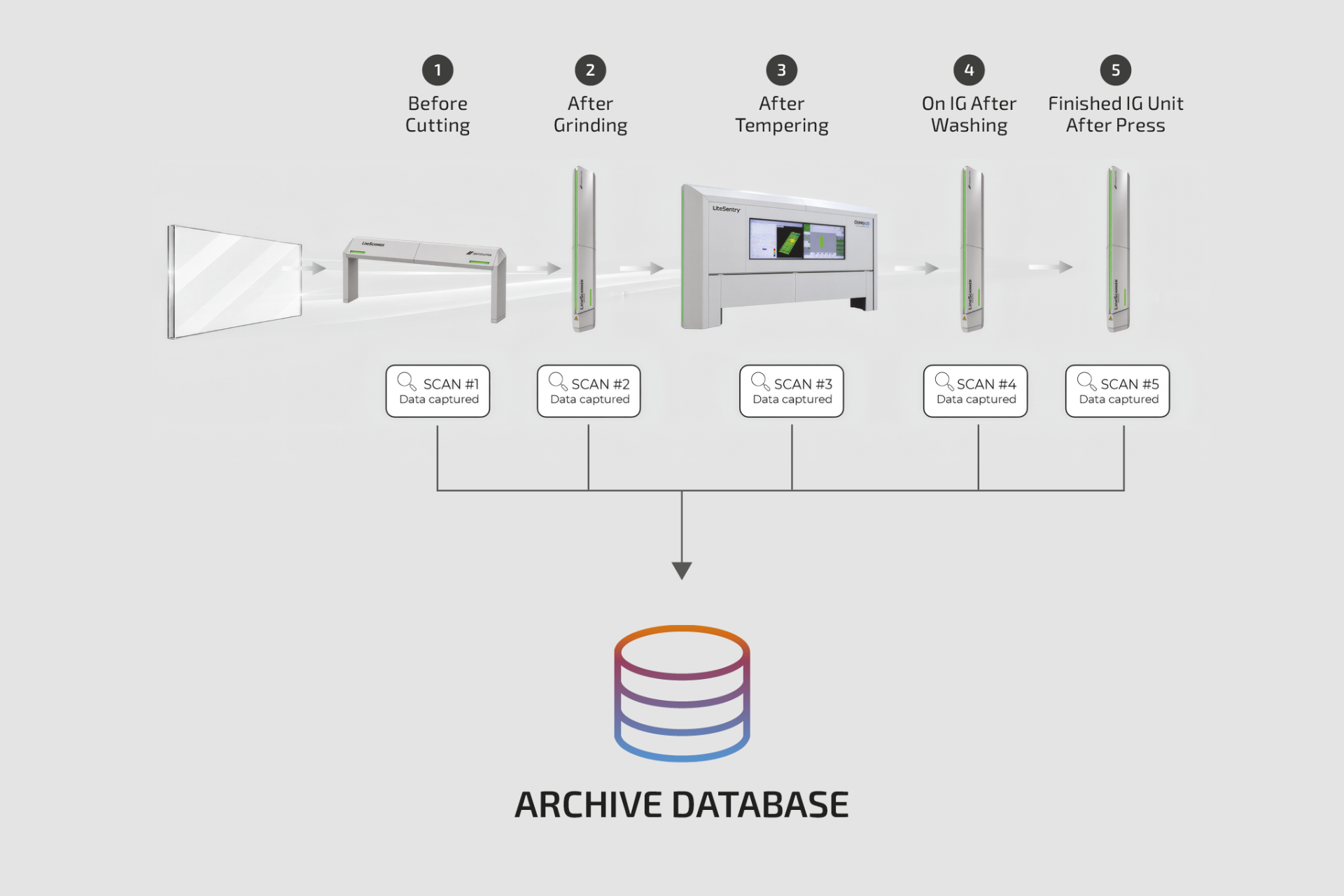
Osprey®25. Archive & Production PV Trend
One Glass Pane. Multiple Inspection Points. One Complete History.
Every scan lands in an SQL-based database and rolls straight into trend statistics — good/bad ratios, area scanned, load utilization. See the problem while it’s still cheap to fix.
Certificates
Different report formats to hand to the client.
Excel-based statistics
Built on templates that can be extended by the customer individually.
Mass data export
Excel or CSV export, ready for your own reporting pipeline.
Osprey®25. Reports
Better reports turn measurement data into better decisions.
Every report shows the pass/fail results for distortion, anisotropy, and dimension quality at a glance,with each measured value next to its threshold. Color-coded distortion and anisotropy maps show exactly where deviations occur. Scan ID, batch, order, operator and certification date make every pane fully traceable. Statistics reveal how distortion and edge lift develop over time, before they become quality issues.
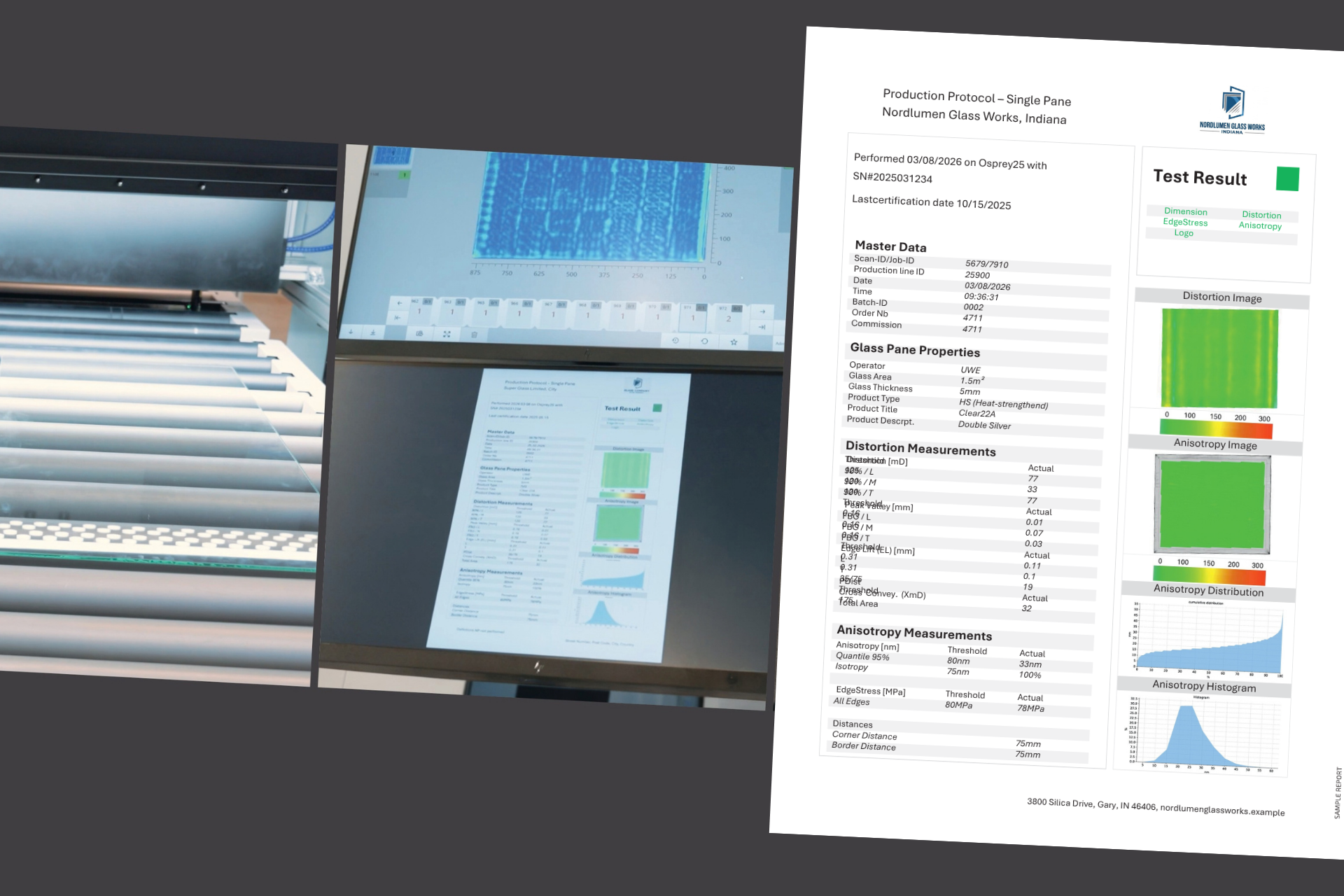
Reports that make quality visible.
Osprey®25. What satisfied users say
Interested in Osprey®25?
Secure customer commitments and advance your opportunities with real-time, online, complete and precise inspection.
Osprey®25. FAQ
Straight answers. Everything you need to know about distortion, anisotropy and reports.
What is Osprey®25?
Osprey®25 is an inline optical inspection system for tempered flat glass that measures distortion, anisotropy and surface quality in a single pass at the furnace exit. It scans 100% of every lite, edge to edge, in real time.
What types of distortion does Osprey®25 measure?
Osprey®25 measures all distortion types in all directions, including roller wave, edge lift, spherical distortion, center kink and mixed forms. It projects a circle pattern onto the glass and calculates a complete deformation map from the resulting ellipses.
What is the difference between peak-to-valley and millidiopter?
Peak-to-valley measures the depth of a distortion, while millidiopter measures its shape, which is what the human eye actually perceives. Osprey®25 reports both, in mm or inches.
How accurate is Osprey®25’s anisotropy measurement?
Osprey®25 measures anisotropy from 10 to 800 nm with ±10 nm accuracy. Customer field data shows a maximum deviation of ±2 nm across rotation angles of 0°, 45°, 90° and 135°.
How does Osprey®25 compare to a roller wave gauge?
Manual flat-bottom and three-point gauges sample only one side, skip leading and trailing edges and can miss peaks or valleys. Osprey®25 measures peaks and valleys on both sides of the glass, including full edge lift, on every lite.
Can I export Osprey®25 data for my own reporting?
Yes. Osprey®25 stores every scan in an SQL database and offers mass data export to Excel or CSV, customizable Excel-based statistics and certificate reports for customers. It connects directly to ERP and PLC systems.
Who supplies Osprey®25?
Osprey®25 is a patented system with more than 800 installations worldwide and over 25 years of development history. Sales and service are provided by Softsolution in Europe and LiteSentry in North America, both part of Industrial QC.
Still have a question? Talk to Sales — we’ll answer it directly.